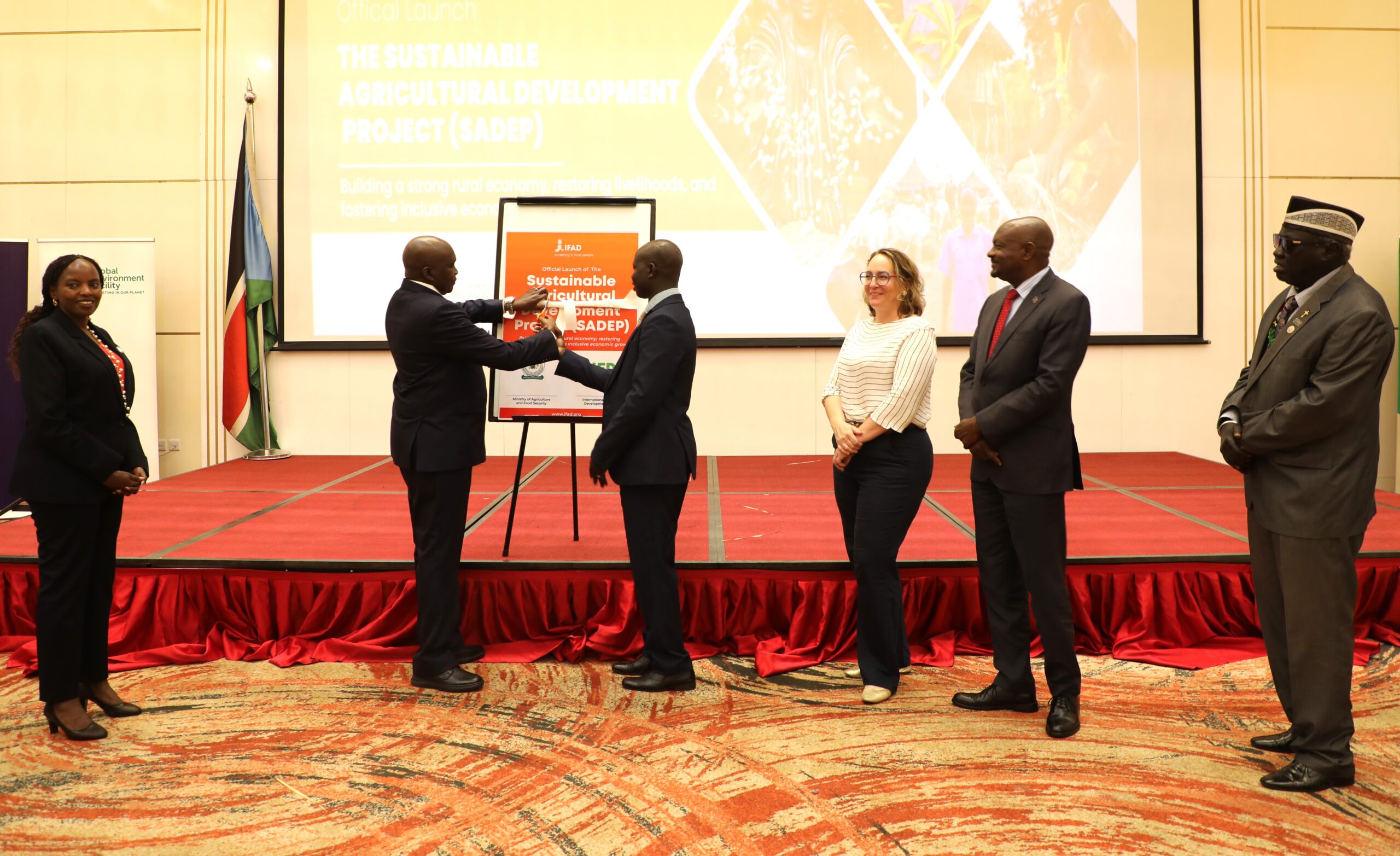
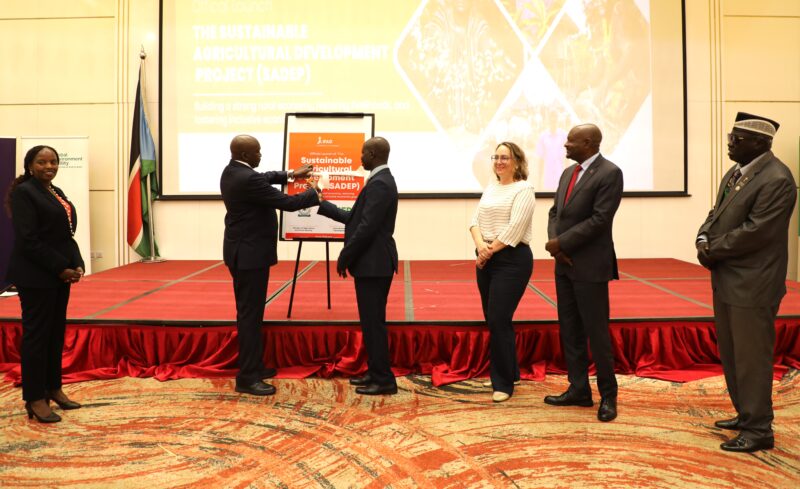
Hon. Prof. Dr Michael Roberto Kenyi Legge, MAFS Undersecretary, and Henry Alana of IFDC sign the SADEP implementation agreement between MAFS and IFDC, witnessed by Hon. Onyoti Adigo Nyikwec, Hon. Clement Juma Raphael Mbugoniwia, and IFAD Country Manager Caroline Mwongera.
July 21, 2026 –Juba, South Sudan – The Government of the Republic of South Sudan, through the Ministry of Agriculture and Food Security (MAFS), has officially launched the Sustainable Agriculture Development Project (SADEP), funded by the International und for Agricultural Development (IFAD) to increase agricultural productivity, strengthen food security, build climate resilience and transform smallholder farming into a more commercially viable sector. MAFS, as the lead executing agency, has contracted the International Fertiliser Development Centre (IFDC) to implement the project, with Welthungerhilfe (WHH) supporting implementation under its contractual arrangement with IFDC.
Speaking at the launch, Hon. Clement Juma Raphael Mbugoniwia, Minister of Agriculture and Food Security, said SADEP comes at a pivotal moment as the Government seeks to reduce dependence on oil and position agriculture as a key driver of economic diversification, employment and national development.
“SADEP must be more than another agricultural project. It should translate our national agricultural priorities into tangible results, more production, stronger markets, higher farmer incomes and greater food security,” Hon. Clement Juma said.
The project will support increased agricultural productivity, stronger producer organisations and value chains, improved market access, climate-resilient production, and greater economic opportunities for women and youth. It also provides an opportunity to advance key recommendations of the South Sudan Agriculture Conference 2026, including the shift from subsistence to high-value commercial agriculture, stronger cooperatives, expanded agricultural finance, mechanisation, irrigation, climate-resilient technologies and increased private-sector participation.
Hon. Prof. Michael Roberto Kenyi Legge, Undersecretary for Agriculture and Food Security, emphasised the need to translate the project’s investments into measurable improvements in the lives of rural communities, noting that successful agricultural transformation requires coordinated action among Government, development partners, implementing agencies, the private sector and, most importantly, farmers. He stressed that every resource invested must ultimately result in increased production, improved incomes, stronger market access and more resilient farming communities, with transparency, accountability and effective monitoring remaining central throughout implementation.
Speaking on behalf of H.E. Gen. Prof. Dr James Wani Igga, Vice President of the Republic of South Sudan and Chairperson of the Economic Cluster, Hon. Onyoti Adigo Nyikwec, Minister of Livestock and Fisheries, said the launch represents another important step in translating the Government’s economic transformation agenda into practical investments.
“Our long-term prosperity cannot depend on one commodity alone. We must diversify our economy, and agriculture—including crops, livestock, fisheries, forestry and their associated value chains- provides our greatest opportunity to achieve this transformation,” Hon. Onyoti said.
He called for timely implementation, transparency, accountability and strong community ownership, stressing that success must ultimately be measured by improved harvests, higher household incomes, stronger markets, more jobs, better nutrition and more resilient rural communities.
The launch brought together representatives of the Ministry of Agriculture and Food Security, Ministry of Livestock and Fisheries, Ministry of Environment and Forestry, Ministry of Finance and Planning, IFAD, IFDC, Welthungerhilfe (WHH), the Kingdom of the Netherlands, World Bank, UNDP, UNOPS, African Development Bank, State and County Governments, development and implementing partners, private-sector and financial institutions, farmers’ organisations and cooperatives, women and youth groups, civil society, and the diplomatic community. The launch reinforces the Government’s commitment to working with these partners to harness South Sudan’s vast agricultural potential for sustainable food security, rural employment and economic prosperity, while drawing lessons from previous investments to strengthen the effective and sustainable implementation of SADEP.