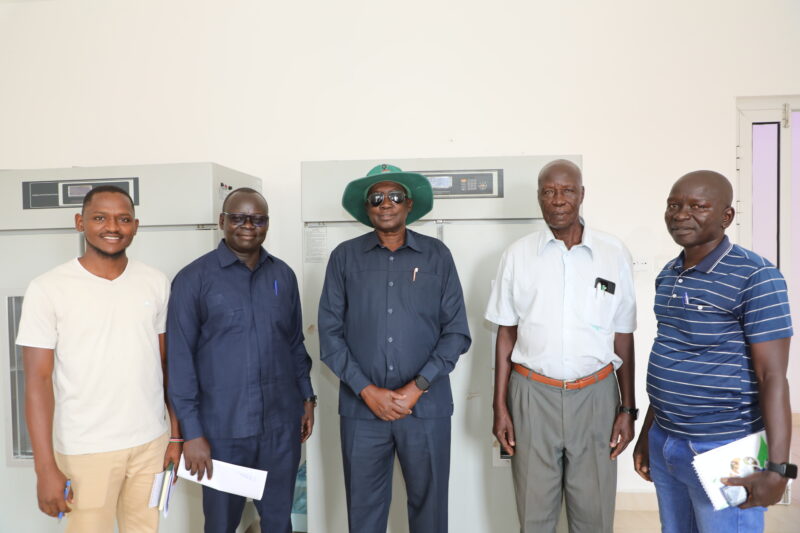
Kapuri, Juba | 19 June 2026 – The Ministry of Agriculture and Food Security’s Undersecretary for Agriculture and Food Security, Hon. Dr Michael Roberto Kenyi, on Friday conducted an official visit to the Entomology Laboratory in Kapuri, Juba. The visit was part of the Ministry of Agriculture and Food Security’s efforts to strengthen national plant protection systems. It also aimed to improve agricultural research and pest surveillance and control capacities. He was accompanied by the Acting Program Director of the Single Project Coordination Unit (SPCU) of MAFS, Mr Tabule Noah Sylvester, the Director for Plant Protection, Mr Taban Charles, the Assistant Director for Plant Protection, Mr Malish Elinana Were, Mr Anthony Ochan, the SPCU Communications Specialist and the Plant Protection Assistant Inspector, Mr Jackson Philip Zereda.
The visit gave the Ministry’s leadership a chance to assess the laboratory’s operational status. The team reviewed the ongoing pests surveillance and diagnostic activities and identified strategic interventions to boost the country’s preparedness and response to agricultural pests and diseases outbreaks. The laboratory was built through the World Bank-funded Emergency Locust Response Project (ELRP) and implemented by the UN Food and Agriculture Organisation (FAO). The facility was handed over to the government in October 2024.
During the visit, the Undersecretary was briefed by officials from the Directorate of Plant Protection on the laboratory’s mandate and functions. He received updates on current pest-monitoring activities and learned about the major crop pests affecting agricultural production. Ongoing efforts to strengthen Integrated Pest Management (IPM) interventions were discussed. The talks also focused on preparedness for transboundary and invasive pests, such as Fall Armyworm, Desert Locusts, Quelea birds, and storage pests. These pests continue to threaten food security and agricultural productivity in South Sudan.
The Undersecretary toured the facility and inspected the laboratory infrastructure, equipment, and technical capacities. These were available for pest identification, diagnostics, and research. He acknowledged the significant investments made in establishing the facility. He also noted several operational challenges that require urgent attention. These include inadequate security arrangements, incomplete installation and commissioning of laboratory equipment, limited internet connectivity, insufficient staff training, maintenance challenges, and the need for improved infrastructure and environmental controls.
Addressing laboratory staff and officials from the Directorate of Plant Protection, the Undersecretary emphasized the strategic importance of scientific research in advancing agricultural transformation in South Sudan.
“Agriculture is a science, and scientific research must remain at the centre of our efforts to improve agricultural productivity, strengthen food security, and protect our crops from pests and diseases. This laboratory has the potential to become a national centre of excellence for pest surveillance, diagnostics, and plant protection services,” he stated.
The Undersecretary directed that the laboratory be fully operationalised and put into active use without delay. He called for the completion of the official handover process for the facility and equipment. He also urged enhanced collaboration between the Directorate of Plant Protection, the Research Directorate, and the Single Project Coordination Unit (SPCU). He stressed the need to develop sustainable operational mechanisms to support the laboratory beyond the lifespan of ongoing projects.
To address security concerns, the Undersecretary instructed the Directorate of Administration and Finance to deploy security personnel urgently. He also called for additional actions, such as installing perimeter protection systems and strengthening facility management arrangements.
The Ministry also pledged to support capacity building for laboratory technicians through specialized training in pest diagnostics, laboratory operations, and equipment maintenance to ensure the facility can effectively deliver its intended services.
The visit concluded with the Ministry’s leadership committing to continue engaging with technical departments and development partners to strengthen South Sudan’s plant protection, biosecurity, and agricultural research systems, thereby increasing agricultural production, improving food security, and enhancing the resilience of farming communities across the country.